
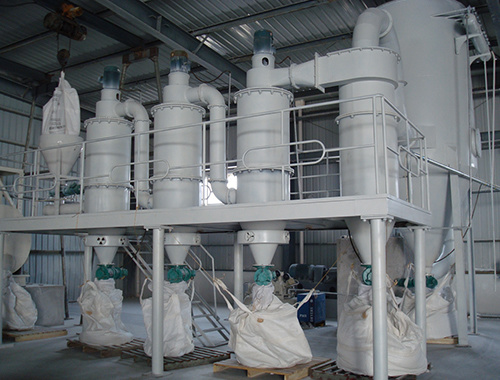
The primary equipment used for powder mixing is the powder mixer. This is a type of cold mixing machine that distributes various powder materials—differing in composition and particle size—uniformly through diffusion, convection, and shear forces. Depending on the internal structure and outer casing, powder mixers are available in multiple configurations.
The main component of a powder mixer is the mixing drum, which can be cylindrical, conical, hexagonal, cubic, or a combination of several shapes. The drum can be mounted horizontally or at an incline. Some drums are equipped with internal agitators, while others are not. The rotating shaft may be centrally aligned or offset. The drum itself may rotate or remain stationary. Regardless of the structural type, these mixers generally achieve mixing by allowing the powder to tumble under its own weight and strike against the drum wall.
A commonly used cylindrical mixer in China consists of a steel drum lined with spiral paddles and oblique baffles. The baffles do not extend to the center of the drum. When the drum rotates, the paddles lift the powder along the sidewall to a certain height, after which it falls by gravity toward the central area, causing intense mixing due to particle collision. Material enters through the top feed pipe and is conveyed into the drum by the spiral paddles. Once mixing is complete, the drum reverses its rotation, and the material is discharged from the outlet via the spiral conveyor.
The main factors influencing the mixing uniformity of this type of mixer include powder characteristics, particle size distribution, mixing time, mixing temperature, and drum rotational speed.